
Continued from Homepage
Mary Mackenzie Goodwin’s Unpublished Victorian Travel Diary: Four Women in the Middle East: Camels, Harems, Pyramids, and the Beauty of Palestine (1880)
by Filiz Barin Akman, Social Sciences University of Ankara
Ambivalence and Admiration: Critical Backgrounds
Goodwin’s account stands out for its distinctive blend of a muted missionary perspective, aesthetic appreciation, and personal curiosity, privileging observation and visual pleasure over overt religious or ideological assertion. During the initial leg of their travels in Rome, in addition to visiting St. Peter’s Cathedral, she and her companions toured ancient and iconic landmarks such as the Colosseum and the Trevi Fountain, as well as the Uffizi Gallery, marveling at the artistic refinement and beauty in a manner more commonly associated with the secular male traveler on the Grand Tour. In Egypt and its environs, she makes an interesting trip to the Pyramids, documents her rather perplexed encounters with Sufi rituals, pays an uneasy visit to a Cairo harem, encounters the traveling harem ladies of the Khedive,⁶ shops amusingly at Egyptian bazaars, explores Islamic architecture such as Sultan Hasan’s Mosque⁷ and delights in the distinctive beauty of local costumes as well as the biblical sites of the Holy City of Jerusalem.
Goodwin also meets the long-established missionary Mary Louisa Whately⁸ (1824–1899), a seasoned and prominent British missionary in Egypt—under whose supervision she works briefly as a schoolteacher in Jerusalem (Manley). While Goodwin’s writing reflects occasional elements of Orientalist and Evangelical worldviews, her approach differs from Whately’s more rigidly moralizing and reformist stance, articulated in her books such as Ragged Life in Egypt (1863), Child-Life in Egypt (1866), Among the Huts in Egypt (1867), Scenes from Life in Cairo (1883) and Stories of Peasant Life on the Nile (1889), published by Church Missionary Society and Religious Tract Society. Instead of advancing a civilizing mission, Goodwin’s diary often dwells on the sensory wonders and experiential richness of travel, allowing space for ambivalence and admiration, ultimately contributing to the diversification of voices in the historiography of East–West encounters. Overall, Goodwin’s hand-written diary detailing her travels from England to Cairo illustrates the ambivalent, gendered workings of Orientalist discourse.
At the time of her travels, in the 1880s, the region was undergoing a period of profound social unrest and geopolitical transformation, shaped by the expanding imperial ambitions of the British Empire in competition with other European powers, alongside widespread administrative corruption, financial crisis, and growing nationalist opposition to Ottoman rule. British imperial policy increasingly pursued cultural and civilizational influence, often advancing Anglican Protestant missionary activity, which frequently came into conflict with Catholic proselytizing missions supported by France and Italy (Cox The British Missionary Enterprise; Carey God’s Empire: Religion and Colonialism in the British World, c.1801–1908).
William Gladstone⁹—an associate and correspondent of Goodwin’s father¹⁰—was the prominent British prime minister of the period, renowned for his strong imperial rhetoric and decisive role in reshaping British foreign policy after Benjamin Disraeli’s pro-Ottoman attitudes. His political stance marked a shift away from Britain’s earlier support for the territorial integrity of the Ottoman Empire, particularly after the Russo-Turkish War of 1877–78. Egypt, then a nominal province of the Ottoman Empire, and Jerusalem, a city of immense religious significance, would soon come under British control, effectively ending Ottoman rule in these regions in the early 1880s.
Although Goodwin had returned to London before these political developments fully unfolded, and her diary appears to display an intentional reticence toward overt political commentary, her travels nonetheless took place against the backdrop of these unfolding imperial realignments. Her experiences must be understood within this broader historical framework, where British missionary and imperialist efforts intertwined, reflecting the era’s prevailing Orientalist narratives and power dynamics in Egypt under the fading Ottoman Turkish rule. Her relative silence on the overt political agendas of the Empire and the ideological imperatives of missionary activism reinforces my reading of her travel narrative as marked by ambivalence and as less rigidly aligned with dominant Orientalist discourse.
Overall, although Goodwin’s account may be shaped by her position within late nineteenth-century British imperial and missionary contexts, it nevertheless reveals a distinctive tone marked by personal curiosity, a measure of cultural openness, and sustained aesthetic appreciation and sympathy. Her later role as president of the Cumberland Orchestral Society, her admiration for the performance of a female violin ensemble in Cairo, her enjoyment of the Queen’s Band in Rome, her informed observations of artworks in the Uffizi Gallery, and the sketches attached to her diary, all serve as illustrative examples, drawn from both her travels and her life after returning to England. Goodwin’s language may occasionally reflect what Edward Said defines as the Orientalist construction of the “Oriental Other” (Orientalism 1–3), while her simultaneous fascination and discomfort exemplify the colonial ambivalence theorized by Homi Bhabha (Location of Culture 85–92); however, her diary further participates in a gendered, observational travel gaze shaped by spectacle and visual curiosity (Pratt Imperial Eyes 8–9), characteristic of nineteenth-century women’s travel writing, which often oscillates between aesthetic appreciation and colonial distance (Mills Discourses of Difference 3–6; Lewis Gendering Orientalism 1–9; Melman Women’s Orients 1–14).
Since relatively little biographical information about Mary Mackenzie Goodwin is available, I have gathered all accessible data from online sources, including family ancestry records, her obituary, and her will. My reconstruction of her life story is therefore necessarily framed in part through her association with her father, the prominent English clergyman Harvey Goodwin, a well-known public lecturer, as well as through her connections with figures such as missionary Mary Louisa Whately and Prime Minister William Gladstone.
Goodwin was born in Cambridge shire in 1855 as the last of seven children born to the parents of a famous English clergyman Harvey Goodwin and Ellen King, eldest daughter of George King of Babington Hall. Even though we do not have details about her early life and upbringing, both her travel diary (via her articulate references to Roman and Greek mythology as well as learned allusions to Roman poets and antiquity) and her parents’ privileged social status indicate that she must have received a quality education. In 1880, as a young woman of twenty-five she traveled to Ottoman Egypt and Palestine as a part of Evangelical mission and taught briefly at missionary schools there. Unlike Whately, she spent a limited amount of time in Egypt and its environs and, as some other documents (like her obituary and inheritance document) suggest, she spent the rest of her life after her return from the Middle East in Oxford, England. She was never married, and she dedicated her life to children’s education in her father’s parish. She was one of the founders of Carlisle Musical Festival and served as the president of the Cumberland Orchestral Society. Unlike Whately, Goodwin never returned to Egypt or the Middle East for missionary activities. She died in 1926 as a single woman and buried in Keswick family cemetery. She left the income that she inherited from her father to the music society she founded and dearly supported through her life.
Ultimately, despite the occasional Orientalist inflections shaped by her missionary identity and imperialist cultural conditioning, Goodwin’s diary offers valuable insights into the intersection of gender, faith, and empire, while contributing to the broader recovery of women’s manuscript literatures and illuminating the complexities of cross-cultural encounter in the age of empire during the last quarter of the nineteenth century.
Excerpts from the Diary: Thematic Highlights
On Visiting Bologna:
“Feb. 19.20 We arrived at Bologna at 3.40 and got into a very good omnibus which we felt to be hopeful, as we always find that good hotels have good omnibuses & vice versa. Our surmises proved correct for the hotel we soon arrived at a palace. We were ushered by sleeping waiters into the most beautiful rooms, two of them furnished with pale blue satin with beautiful painted antimacassars, exquisitely frescoed ceilings, and coronets over the muslin draped pointed dressing table. We went to bed & slept soundly for some time, then got up, had breakfast, & then started out & walked & drove about that most exquisite city. The men who as a rule are extremely handsome stand in picturesque groups, with cloaks thrown over their right shoulders. The picture gallery was delightful several beautiful pictures of Francia’s, & Perugino’s. The town itself is perfect; every house different, pillars, colonnades, balconies & towers (the 2 leaning ones). We went to the oldest church¹¹ in Bologna – it is in 4 parts one made to imitate the court of Pontius Pilate¹² and there is a marble pillar said to be the exact height of our Lord. The old courts have pillars all round with every capital different, & houses tumbling, & heaped one above another, paved streets with a dip in the middle.”
On Visiting Florence:
“Feb. 21 We went to the Uffizi gallery first, & really felt as if we had never seen a picture before. The Tribune with its exquisite gems which no words could describe, and Fra Angelico’s & Botticelli’s pure quaint pictures seem to belong almost to a different sphere to the pictures of the present day.”
~*~
“We then went to the Church of Sante Croce where Michael Angelo’s tomb is side by side with that of Dante. There are some more of Fra Angelico’s frescoes in the little side chapel the most beautiful being “The death of St. Francis”. The Cathedral is very fine, but it was so dark when we went in that we could hardly see. We then went to Mr George Saul’s studio. He was out, but the handsome Italian boy who opened the door to us showed us his sculptures. We then took an open carriage and went for a long drive round the new road which has been made half round Florence, and from the highest part of which we get the most exquisite view over the whole city with the distant hills. We made the acquaintance of Mr. Shore who knows the Spencer Bells very well. We bought some photographs in the evening and walked towards Giotto’s Tower which is very beautiful. It is truly called a city of flowers.”
On Visiting Rome:
“Rome was different to what we expected there was so much grass… After lunch we went to St. Peters. It was with feelings of awe and admiration that we drove up between the fountains to the foot of the long flight of steps leading up to the entrance. We inserted ourselves as best we could under the heavy carpet curtains that answer the purpose of doors, and then stood for a few minutes to try & realize ourselves. Everything was so colossal, and yet in such exquisite proportion that it was impossible to realize the size. The cherubs holding gigantic shells which hold the holy water, look like small children and yet they are immensely larger than a man. The image of St. Peter is the smallest of all, his toe is quite worn away with kissing. He is jet black and his name used to be Jupiter.”
~*~
“We came perpetually on bits of Old Rome all amongst new Rome. Trajan’s forum with hit broken pillars, etc and all the old bits are on such a much lower level than the new.”
~*~
“We started about 10 for the palace of the Caesars which took about 3 hours to go all over. It is a most wonderful place. Some frescoes still remain in Augustus’ & Olivia’s private rooms, and we were shown the exact spot at the foot of a marble staircase where Caligula was assassinated. The banqueting halls and places for a chariot, horse & foot races, and all sorts of games, were very interesting and we felt as if we had got back into the first century.”
~*~
“Feb. 26 went over the Church of St. Clementi before breakfast and afterwards we went to the Vatican where we hoped we might see the Pope who is very sulky and proud. Just now, infallible man & won’t come out of his den because the king has chosen to make Rome his capital, but we were disappointed. The pictures were very striking, but except the three greatest in the world ‘The Transfiguration & the Madonna Di Foligino’ by Raphael and Domenichino’s ‘Last Communion of San Jerome’ were not nearly equal to those in the Florentine galleries. The painted ceiling by Michael Angelo of the Sistine Chapel is most wonderful, but it is impossible to look at it long, it gives one such a headache, and it was rather a relief to go on to the St. Lorenzo Chapel the walls of which are beautifully frescoed by Fra Angelico. We lunched in a café then went into St. Peter’s again, driving from there through the Borgliese (sic) [Borghese] Gardens which were bright with Italian sunshine, and where after a long waiting we saw the Queen’s Scarlet¹³ liveries approaching. She got out and walked for some distance, which is her general custom. She is tall and very sweet looking & bowed twice to us as she passed; we drove on to the Pincian¹⁴ from there, where the elite of Rome were assembled to see and be seen and listen to the band. After dinner we went for the last time to the Coliseum, going over it much more thoroughly than before. There were a great many people there, and the effect of the bright torch light, contrasting with the silvery moonlight, & long deep shadows, was weirdly beautiful. We went to the very top, through arch after arch following the flickering red glare as closely as we could, for broken staircases & small wells were numerous. The fountain of Trevy gleamed with silver as we drove home past it, and we threw in a maiedi (sic) [probably a medjidie¹⁵] as we wished very much to come back again.”
Upon Arrival at Alexandria:
“March 2. We went to bed thinking “If all’s well tomorrow we shall be in Africa.”
~*~
March 3rd was a day long to be remembered. G. and Miss MacInnes slept in the saloon for the sake of the air. We got up about 6.30 and while we were dressing saw the pilot’s boat come alongside. The pilot came on board about 7 just like an old woman. 3 other Egyptians were in his boat with melancholy faces & to all appearance no legs, dressed in rags & turbans. We came into the great harbour splendidly going up on deck we saw the long low line of coast on either side getting nearer & nearer. Crowds of picturesque brown sailed boats came clustering round the ship as we stopped, & then all the occupants of the said boats came swarming over the sides of the vessel, coming up just like monkeys, and the most peculiar and awful chattering ensued. Cook’s¹⁶ boatmen were conspicuous by their red jerseys, Aquilina (Angelina)¹⁷ at their head. He got us off among the first with an American party who seemed very nice.”
~*~
“We got to land first & were tugged up a small wall by Arabs a hundred of more of whom were ready with outstretched hands, all in the most charming dresses. It was most frightfully hot. We had to wait some minutes before the other boat arrived when we welcomed them with great cordiality into Africa. The next half hour was the most exciting I ever spent and we felt it would have been well worth the journey if we had had to go back an hour afterwards. We went to Hotel Europe in a carriage with a roof, passing endless people sprawling about the streets. The young boy’s dresses were extremely simple consisting of one garment generally of blue or white cotton, the red, black tasseled fez being the only other thing worn. Gentlemen’s sons are more like this. Brilliant dresses with pointed red leather shoes. The women in their long blue veils carry their babies astride on their shoulders balancing themselves with perfect ease and they sit for hours without moving in a position that would give us cramps in 5 minutes. Donkeys abounded, small and shaven. For some reason known only to themselves the riders prefer to be as far away from the heads of these docile & melancholy beats as it is possible to be with any chance of safety, and the effect of these grey wooden looking beasts with men or boys balanced on their extreme end, galopping (sic) tranquilly along the streets is grotesque in the extreme.”
On Bathing Houses and Customs of Local Arab Women:
“March 3 We bathed in nearby bathes directly we arrived at our hotel which we arrived at down a flight of marble steps, going into a court with palms and flowers. We then had breakfast & the most delicious coffee, & then stayed in our room writing and painting till after lunch, when we went out to see Pompey Pillar¹⁸ and afterwards into the Pasha’s garden which was like fairy land, such exquisite roses, geraniums, Nile lilies in ponds, great waving date palms, bamboos, aloes, & hundreds of things we did not know. We watched women washing vegetables in the Nile, as we went back, and met a lot of goats with long ears like lop eared rabbits. Miss F. went to Ramlah¹⁹ in the in the morning to see schools, drove through the bazaar, and afterwards for a long walk.”
On the Traditional Costumes of Local People in Cairo:
“March 4 The dresses of the people are magnificent and the swinging stride with which the Arabs advance on their way is quite imposing. One dress we saw this afternoon on a fine tall man was clean gold silk waistcoat and loose trousers – in one long fawn coloured coat over it, and a splendid India shawl pattern girdle and turban. Everyone dresses differently, and all in such perfect taste.”
On Meeting Mary Louisa Whately and Visit to Her Schools in Cairo:
“March 5 After breakfast we went to see Miss Whateley (sic) with Miss Jourdan. She took us over her schools where she has 500 children now, some with most glorious eyes, but I should think 70 out of every 100 if not more are ruined by ophthalmia. Miss W has the medical mission now, as well as her schools, and everything is most interesting. Some of the work the girls were doing was marvelous broad silver thread on muslin, & silver and gold twist on black velvet.”
On Landscapes and Daily Life in Jerusalem:
“March 16 It is a most picturesque town; sudden streets down steps, all roofed with stone like tunnels, other streets sheltered from the sun with awnings of ragged matting. Crowds of people, donkeys & camels in all the streets, the riders of these latter, such splendid men, clad in rags, & with the same composed wistful type of Arab face.”
On Shopping at Cairo’s Bazaars:
“March 5. We drove home through the bazaar which were very curious. In the very narrow ones they say you cannot even go on a donkey as there is only just room for two-foot passengers to pass. They are nearly all very narrow with shops on each side. The plans of which are I should think about 2 ft. square a shelf in the middle on which the owner of the shop sits cross legged, with all his goods hung round him, but mostly over his head. … The orange gardens are lovely and the palms – accacias (sic) line most of the streets, and men, donkeys, cows and camels sprawl about the place so promiscuously, that how it is no one is killed is almost beyond our comprehension.”
~*~
“March 10. The bazaars are very narrow with the shops arranged on each side & coloured goods hanging up in front. Each shop is about 6 feet square, the owner sits in the middle often smoking a nargilleh.²⁰ The arched stone roofs keep them cool & dark and streams of gorgeously dressed people block up the way or are crowded into a heap by a pathetic & splendid human being on a patient ass with radiant trappings. We went first to the Egyptian bazaar²¹ where Miss J had been arguing the price of some splendid dishes for some days. She got them for hers this time, which I think was a little less than a third of what they first asked. We then went to the silver bazaar, one of the narrowest of all. A chair was put on the counter for G. Miss J sat on the edge of the shop while M had a chair in the street & I sat in the shop on the opposite side, so that there was only just room for people to pass in single file between me & Mr. Mounsey. We had the most delightful time of bargaining & contradicting. I bought a silver bangle with bells for Janet and a pair of studs. At the brass bazaar, I got 2 brass trays, a pair for the price they asked for one, and at Joseph Malluk’s²² we all bought tablecloths, white Indian muslin worked with yellow silk. We also bought a coin necklace & bracelet – everything goes slowly except their tongues in the bazaars, & the carriages in the open streets, both of which fly.”
On Visiting Sufi Orders and Dervish Lodges in Cairo:
“March 5. Directly after lunch we went to see the dancing dervishes²³ which was another most extraordinary sight. All the English seemed to be going, as Friday is the only day they perform on, and all in carriages & pair, some with outrunners & some without and really it was quite a miracle that they all arrived without killing a single person. We tore along the narrow streets up little mountains in the road and down little precipices bumping up against donkeys & camels & once crushing flat, a load of sugar canes that was trailing off a donkey’s back & the heat and dust was as if the whole desert were coming down on the top of us. After seeing the dancing dervishes we went to the howling dervishes, which were much more interesting, for the dancing ones consisted in sitting for a long time in an enclosed circle with bowed heads, while a man from the balcony made a noise at them for nearly for about ¼ of an hour like a very loud and prolonged yawn. They then marched 3 times round the circle, bowing to each end and the chief’s neat (the chief – unfortunate being was clad in a sable cloak) – and then spinning round faster & faster. But the howling dervishes had long hair down to their shoulders, which they flung first nearly to the ground in front, & then behind with roars like lions. The place they were in was like a vaulted castle & weapons hung on one side, which they used to cut themselves with, but they have given up that habit. It was most interesting and curious, but dreadfully sad to think that that is their religion.”
On Meeting the Harem of Khedive²⁴ in Cairo Streets:
“March 5. We met some of the Khedive’s harem in close carriages on our way home soon after we got through the old gateway which is very magnificent, very ancient a great height, with heavy iron doors. We always know the Khedive’s people by their splendid sifce²⁵ (Sic)[ferace] (outrunners) who do go at a pace. They wear white India muslin knickerbockers with Indian girdle & short black open coats thickly embroidered with gold and sleeves like a bishop’s held on by being hooked together in the middle of their backs. With their copper faces & legs & long sticks, they look very striking. Nearly all the women are entirely veiled up to their eyes the nose veil being connected with the piece over the head by a thing like brass reel with ridges, the whole thing being called a yak-mash (sic) [yaşmak].²⁶ The orange gardens are lovely and the palms – accacias (sic) line most of the streets, and men, donkeys, cows and camels sprawl about the place so promiscuously, that how it is no one is killed is almost beyond our comprehension.”
On Visiting Sultan Hasan Mosque²⁷ and The Citadel²⁸:
“It has been much cooler today though it feels very hot again this evening. Miss Fox, G & I went to Sultan Hassan’s mosque this morning. We had to put on great big rush slippers over our boots before going in, & it required great ingenuity to keep them on, but the fear of losing our lives if they came off, helped us considerably. It was most interesting and curious, with a great pool in the middle where the worshippers wash. All the buildings are very high. We then went to the citadel, the mosque of which is gorgeous all made of alabaster & beautifully carved. The floor is entirely covered with Turkey carpets²⁹ of different thicknesses & patterns. Mahomet Ali³⁰ is buried there in an alabaster tomb, but it was covered up with crimson when we saw it. From the citadel we had a splendid view over Cairo with its minarets and domes, the pyramids in the distance and beyond them the long yellow line of desert with the aqueducts which the Israelites built in the time of Joseph, between the pyramids and the town. But for the minarets & domes, Cairo would be an unbroken line of mud colour. We then went to the palace where the Khedive holds all his grand receptions, some of the rooms were very fine, but had no furniture except richly cushioned divans all round the walls. We next went to Joseph’s well.”³¹
On Visiting the Pyramids:
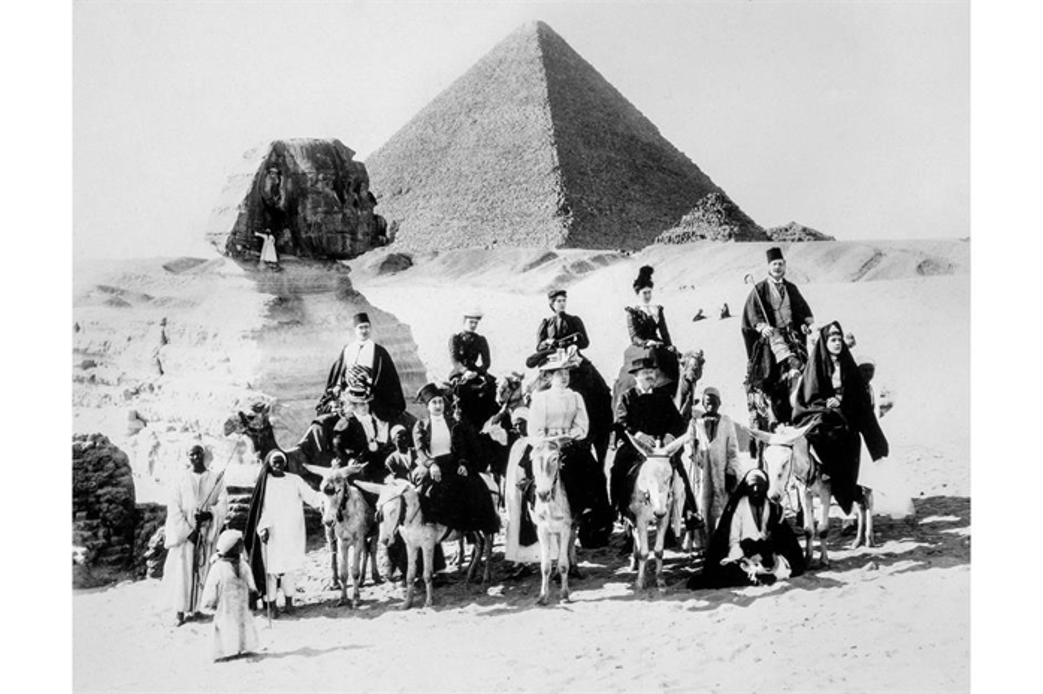
“Tourists in Egypt in front of the Sphinx” (1890). This late 19th-century photograph of Western/English tourists mirrors the narrative in Goodwin's diary describing her and her friends’ visit to the Giza pyramids. (Hirarchivum Press/Alamy)
“March 8. Miss MacInnes was so much better that at 9.30, we started in carriage for the Gizeh (sic) [Gizah] Pyramid.³² We had a jet black Nubian Syce³³ with the most wistful face you can imagine. The sun was very hot, but there was a fresh wind, which was refreshing. When we got as near as the road went to the Pyramid we took donkeys, nice cheery little donkeys with red saddles which came off, at least mine did, and landed me in the sand, an easy fall, as it is not far from the top of an Egyptian donkey back to the ground, and a nice soft bed when you got there. On arriving at the little house built for the Prince of Wales when we came we were surrounded by covetous Arabs claiming backsheesh-backsheesh,³⁴ though what right they had to our money I never could discover. They all talked loud & fast, each informing everybody of their own immense superiority to their neighbours, so that it was difficult to choose an escort, as everybody was the best. At last we got off and found Gulie & Beatrice Mounsey, who had started hours before us. G had 3 Arabs, but they only allowed me two, which was mean. I don’t think as a rule the steps were more than from 3 to 4 feet each so we got on very well, resting 2 or 3 times. G & I meeting one another at the broader ledges where we rested, and our escorts evidently comparing notes on their different charges. Perhaps it was as well that we didn’t understand Arabic. My way was cheered by songs of ‘Yankee Doodle’ sung in English with a strong Arabic accent, to an Arab tune which must be heard to be appreciated; I should say 2 Arab tunes, for though very similar in sound & I think in the same key, one man was much longer in arriving at the end of his performance than the other. When we arrived at the top we felt very pleased, & were quite ready to rest; it was about 12 o’clock. We looked for Harry’s initials, but could not find them. We were shown the Prince of Wales’ etc. and then our Arabs with the air of people conferring a very great favour offered to run down that pyramid & up in the next 5 minutes, for 20 francs. We told him we thought it much too hot, and said we couldn’t possibly afford it. We even refused when he brought it down to 2 frcs. There is nothing to say about the view as it was all obscured by wind & sand only stretch after stretch of desert to be seen with a hazy horizon. We were brought down on the Sunny side, as the Arabs said the other was too cold & we should be blown away; the heat was awful and we felt quite exhausted when we got to the bottom. We found Miss M.I. had made 2 lovely sketches, and Miss Fox had been in the inside. We wanted to go but were too tired out, so we sketched 3 Arabs in blue robes sitting on their feet with white turbans & melancholy motionless faces. One man sat without moving a muscle for an hour & a half. We had some food & made great friends with the Mounseys; about 3 we got on our donkeys & rode round the Sphynx; which hasn’t the perfect features often represented in wood-cuts but which is very fine & calm & grand. We rode across to our carriage & I sketched a very rough sketch of the pyramid, while we were waiting for miss F. who was about 5 minutes behind us. She had been inside the Pyramid while we were going up, and then to see her brother’s grave, who died there; She found a Sheikh who knew him & remembered him quite well which was very nice for her. G. had hurt her knee rather, going up & it began to be very stiff on our way home.”
On A Harem Visit in Cairo:
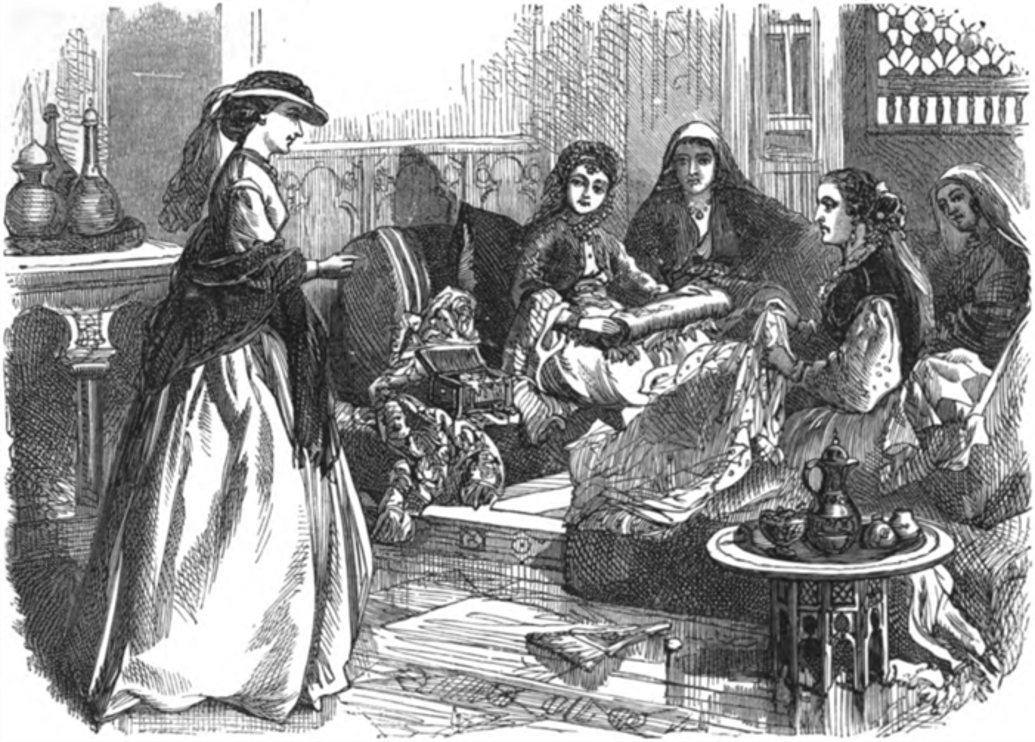
This image provides a representative visual recreation of Goodwin's harem visit, as mirrored in Maria Louisa Whately’s The Story of a Diamond (1867), which depicts an English woman’s visit to a harem in Cairo. Whately was a long-resident English missionary visited by Goodwin and mentioned in her diaries.
“March 9. After which [a visit to Heliopolis] we went with Mrs. Shakour³⁵ (Miss Whateley’s adopted daughter) to a rather grand harem. It was very interesting & funny. We went into a kind of court with an arched stone roof, out of which opened the men’s room. Then we went upstairs, dirty & narrow, to a moderate sized room where we found Miss W’s pupils & her mother, both very fat & dressed in red and black check. The room was simply furnished with divans round & a sort of carved cupboard with a shelf at one end. They immediately brought cigarettes for us to smoke. At least Miss M.I. & Miss F (G & I were considered too young I imagine) who smoked away as if they had been brought up to it & were very proud of their performance. Then a sort of awful marmalade was brought round in a jar which unfortunately we were considered old enough to partake of! We all ate it with spoons then came immense bowls of sherbet, one each, not a drop of which we were allowed to leave and G & I began to long for deliverance & to wonder what could come next. Our curiosity was soon satisfied; coffee was brought in by black servants. (The daughter had handed all the other things, as a mark of respect). We all had to drink the coffee which unfortunately I never could get to like. Then we looked at the good lady’s diamonds, and she looked at our bangles & compared the white silver to their dark heavy bracelets, & then put them & our rings on her own hands, and then having been there nearly 2 hours we came away; the lady patting us on the back & very sad that we wouldn’t stay longer.”
On A Coptic³⁶ Wedding in Cairo:
“March 11. In the evening we went to the wedding of Mr. Naseef’s sister. Miss Whateley’s young pupil-teacher; a pretty girl, who was very frightened. The wedding was in the drawing room. Mr. Jackson reading the service in English, an unknown tongue to the bridegroom who made rather a muddle of the words he had to say. There was a christening before the wedding of the bride’s little nephew: a splendid baby. The men were all in one room & the women in another. The Copt women in pink satin & gorgeous diamonds were like enormous feather beds. The men with their dark faces & red fezs were very picturesque. After the ceremony Miss J played many Scotch tunes, & great trays of sweets & cakes were handed round.”
On Palestine,³⁷ Jaffa and Jerusalem:
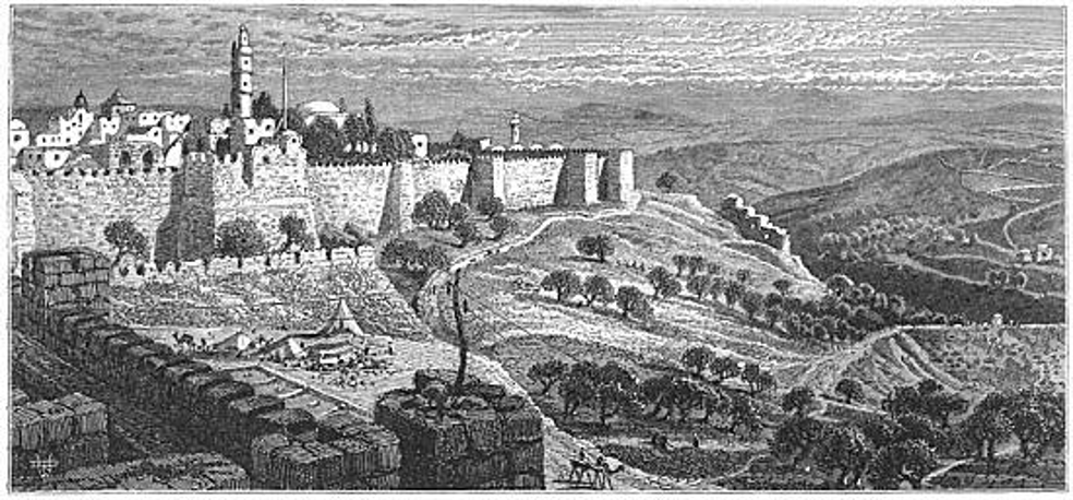
An 1881 engraving titled "Old City of Jerusalem and Hinnom Valley," featured in the volume Picturesque Palestine, Sinai, and Egypt, edited by Charles Wilson.
“March 16. We arrived under a wall where we had to stand on the edge of the boat & be pulled into Palestine by dozens of willing brown hands. O how they chattered. I arrived in Palestine on my knees and we waited for some time in a sort of cave, sitting on a sack, till carriages were ready & G had come. We had to walk some way first through arched streets. Mr. O was dreadfully ill & had to be fed with brandy. Then we got into carriages which held 6, 3 two’s all facing the horse & off we went, bump dash through streets pile with mud & orange groves & prickly pears & sunshine all around, to Jerusalem Hotel. There was a great deal of excitement about us as we had been sighted on Sunday morning, then had disappeared so all sorts of reports about our fate were abroad.”
~*~
“We were taken hither & thither by Aurora Floyd, and Soloman, the most gorgeous specimen of a young Arab Swell, who was dragoman. He swaggered along with a cigar between his fingers, in his magnificent Arab dress of dark blue cloth. We went to the house of one Simon a tanner, from the roof of which we had the most lovely view across the blue seas that had stilled down till it was like glass, the Nevus lying motionless a mile out, on, and on till Carmel showed faint & hazy in the distance. We gathered some plants from the roof; the inside is like a cave, the floor covered with matting. It is a most picturesque town; sudden streets down steps, all roofed with stone like tunnels, other streets sheltered from the sun with awnings of ragged matting. Crowds of people, donkeys & camels in all the streets, the riders of these latter, such splendid men, clad in rags, & with the same composed wistful type of Arab face.”
~*~
“We went off to the roof & had such a view. The mountains of Benjamin Samaria & Judea to the South East, the unruffled changeable sea; the plain of Sharon in front of us radiant with orange & lemon groves, carpets of scarlet anemones & the air sweet with orange blossom.”
~*~
“The country was exquisite, the olives with their grew bloom shone like silver in the sun, and the distant hills of Judea all covered with snow & such lights & shadows.”
~*~
“The sunset was magnificent, sky seemed made golden transparency so exquisitely clear & soft; coming suddenly round a rock, we saw a neighboring hill, standing out against the sky, are eastern shepherd walking slowly along, folled (sic) by his flocks. We had begun to live the bible, & felt sometimes as if we had got back to 1800 years ago.”
Notes
Thomas Cook & Son, founded by Thomas Cook in 1841, was the pioneering British travel agency that played a central role in the development of organized tourism in the nineteenth century. By the 1860s and 1870s, the company had established extensive operations in Egypt and the eastern Mediterranean, offering guided tours, steamship travel, hotel accommodations, and Nile excursions. Cook’s services significantly shaped Victorian travel experiences in the region, facilitating access while also structuring encounters with local environments and populations through a distinctly imperial and commercial framework. Goodwin references multiple times to the Cook’s Company as well as their rivals such as London-based Gaze’s Company.
Harvey Goodwin (1818–1891) was a prominent Anglican clergyman and served as Bishop of Carlisle from 1869 until his death. A respected theologian, educator, and public lecturer, he was known for his engagement with religious education, missionary interests, and ecclesiastical reform within the Church of England.
Her language occasionally participates in what Edward Said identifies as the production of the “Orient” as Europe’s imaginative and hierarchical Other (Orientalism 1–3, 32), while her simultaneous fascination and discomfort exemplify the colonial ambivalence theorized by Homi Bhabha (Location of Culture 85–92). Her diary further participates in a gendered, observational travel gaze shaped by spectacle and visual curiosity (Pratt Imperial Eyes 6–7). As Billie Melman demonstrates, nineteenth-century women travelers often mediated Orientalism through aesthetic curiosity and affective engagement rather than overt political authority characteristic of nineteenth-century women’s travel writing, which often oscillates between aesthetic appreciation and colonial distance (Mills Discourses of Difference 1–5; Lewis Gendering Orientalism 1–4). (Melman Women’s Orients 8–12), while Sara Mills notes that female travel writers negotiated and subtly destabilized imperial authority even as they remained discursively constrained by it (Discourses of Difference 3–7, 18–20). Goodwin’s account thus embodies a specifically gendered colonial ambivalence: curiously sympathetic, aesthetically receptive, yet ultimately shaped by Eurocentric cultural distance and Victorian assumptions.
Egypt and Jerusalem came under Ottoman (Turkish) control in 1517, following Sultan Selim I’s defeat of the Mamluk Sultanate; Jerusalem had entered Ottoman rule slightly earlier, in 1516, as part of the conquest of Ottoman Syria. Egypt remained formally an Ottoman province for nearly four centuries, though it enjoyed increasing autonomy after the rise of Muḥammad ʿAlī Pasha in 1805 and the establishment of the Khedivate in 1867. By the late nineteenth century, Ottoman sovereignty over Egypt was largely nominal, as European—especially British and French—financial and political influence intensified, culminating in the British occupation of Egypt in 1882. Ottoman rule in Jerusalem and the wider region effectively ended during World War I, when British forces captured Jerusalem in December 1917; the empire’s authority was formally dissolved with the Ottoman defeat in 1918 and the subsequent partitioning of its Arab provinces under the postwar mandate system.
The transcription of the diary was made possible through a truly collaborative effort. I am deeply grateful to Maureen Brunsdale, Head of Special Collections at Illinois State University’s Milner Library, for her generous support, warm friendship, and remarkable skill in deciphering often illegible handwriting. She also played a crucial role in preparing the final transcription, building in part upon my own preliminary transcriptions and bringing to them her meticulous attention and expertise. Without her keen eye and dedication, this work would not have been possible. I also contributed substantively to the final transcription by identifying and contextualizing Middle Eastern terminology—particularly Ottoman Turkish and Arabic expressions such as bahşiş, yaşmak, and mecidiye—drawing on my expertise in the linguistic and cultural history of the region. The completed text thus reflects a genuinely collaborative effort, shaped by the complementary strengths we each brought to the project. I would also like to extend my sincere thanks to Prof. Katherine Ellison, Chair of the Department of English at Illinois State University, for facilitating my studies at the university and for serving as my host advisor.
In 1880, the Khedive of Egypt was Tawfiq Pasha (Muḥammad Tawfīq), who ruled from 1879 to 1892.
The Mosque and Madrasa of Sultan Ḥasan, among the largest and most architecturally significant religious complexes in Egypt, was commissioned by the Mamluk sultan Ḥasan ibn al-Nāṣir Muḥammad ibn Qalāwūn between 1356–1362 and is situated at the southern end of Muḥammad ʿAlī Street in Cairo.
Mary Louisa Whately (1824–1889) was an Irish Anglican missionary and educational reformer who established a network of schools in Cairo, aimed at educating poor Muslim and Coptic children, particularly girls since her arrival in 1861. Closely associated with evangelical Anglican circles, her work combined philanthropy, religious instruction, and vernacular education, reflecting broader nineteenth-century Protestant efforts to extend moral and cultural influence within the Ottoman provinces. Her published account, Among the Huts in Egypt (1867), helped shape British perceptions of Egypt as a field for evangelical reform and humanitarian intervention, situating her mission within what scholars have described as the informal religious dimensions of British imperial expansion (Whately; Stock; Carey; Cox). In Letters from Egypt to Plain Folks at Home (1879), Whately for instance, calls on fellow believers in England to join with her in prayer in her efforts to expel ‘falsehood’ of Islam from Egypt: “Let the Gospel light shine into this land where there is so much of ignorance and darkness and false belief” (2).
William Ewart Gladstone (1809–1898) served as British Prime Minister on four occasions: 1868–1874, 1880–1885, 1886, and 1892–1894. A leading figure of the Liberal Party, Gladstone was a longstanding political rival of Conservative Prime Minister Benjamin Disraeli. In the aftermath of the Bulgarian atrocities (1876) and the Russo-Turkish War (1877–78), Gladstone adopted a strongly critical stance toward the Ottoman Empire, condemning what he described as “Turkish misrule” and advocating a moral foreign policy that departed from Britain’s earlier strategic support for Ottoman territorial integrity.
Surviving correspondence from Harvey Goodwin to Gladstone between 1869 and 1891, together with Gladstone’s role in promoting Goodwin to the bishopric of Carlisle, suggests a relationship of professional proximity and likely personal acquaintance. Their exchanges, situated at the intersection of ecclesiastical and political life, indicate that questions of religion, governance, and imperial policy would have formed part of their ongoing dialogue, thereby providing an important contextual backdrop to Mary Mackenzie Goodwin’s travels. Their correspondences located in Letters to WE Gladstone, is held by British Library, Manuscript Collection: MSS 44422-513, Date 1869-91.
The church is the Basilica of Santo Stefano (the “Seven Churches”) in Bologna, a medieval complex of interconnected structures including the Cortile di Pilato (Courtyard of Pilate) and a marble column traditionally said to represent the height of Christ.
Pontius Pilate was the Roman prefect (governor) of Judaea from c. 26 to 36 CE under Emperor Tiberius. He is best known in Christian tradition for presiding over the trial and crucifixion of Jesus of Nazareth, as recorded in the canonical Gospels. Medieval and early modern European legend associated Pilate with various sites in Italy—particularly in Rome—though historically he governed in the Roman province of Judaea and was later recalled to Rome following unrest in the region.
Margherita of Savoy (1851–1926) was Queen of Italy as the wife of King Umberto I and mother of King Victor Emmanuel III; she was the daughter of Prince Ferdinando of Savoy, Duke of Genoa, and Princess Elisabeth of Saxony.
The Pincian Hill in Rome.
The medjidie was an Ottoman coin introduced in 1839 upon the accession of Sultan Abdülmecid I (the 31st Ottoman sultan). It became a principal unit of Ottoman currency and remained in circulation until the end of Ottoman rule, including the period of the Allied occupation of Istanbul (1918–1923). As Goodwin and her companions were traveling to the then Ottoman cities of Cairo and Jerusalem, it is highly probable that they carried Ottoman currency with them.
Thomas Cook & Son was a British travel and tourism agency founded in 1841 by Thomas Cook. By the late nineteenth century, the company organized guided tours to Egypt and the Near East, managing steamship travel, river transport on the Nile, accommodation, and local dragomans and boatmen, thereby playing a central role in facilitating British and European tourism in the Ottoman provinces.
It is plausible that Aquilina/Angelina was a well-known local guide or overseer employed by Thomas Cook & Son.
Pompey’s Pillar is a monumental Roman triumphal column in Alexandria, erected in 297 CE in honor of the Emperor Diocletian. Standing approximately 27 meters high and made of red Aswan granite, it is one of the largest ancient monolithic columns outside Rome and remains one of Alexandria’s most prominent surviving classical monuments.
Ramla or Ramleh in Alexandria, İskenderiye became a major commercial and European residential quarter in the nineteenth century.
Hookah or water pipe.
The “Egyptian bazaar” in Cairo most likely refers to Khan al-Khalili, the city’s principal historic market district, founded in the late fourteenth century during the Mamluk period. By the nineteenth century, it had become a major commercial and social hub where merchants sold textiles, spices, jewelry, perfumes, metalwork, and souvenirs to both local residents and European visitors. Frequently depicted in travel writing as a vibrant and sensory-rich space, the bazaar functioned not only as an economic center but also as a symbolic site of cultural encounter within the Ottoman city.
A notable businessman and his shop.
The “howling and dancing dervishes” refers to members of Sufi brotherhoods (ṭuruq) whose devotional rituals (dhikr) involved rhythmic chanting, swaying, music, and, in some orders, whirling movements intended to induce spiritual ecstasy and remembrance of God. Nineteenth-century European travelers frequently described these ceremonies in sensational terms, emphasizing sound and bodily motion, while often overlooking their theological significance within Islamic mysticism.
In 1880, the Khedive of Egypt was Tawfiq Pasha (Muḥammad Tawfīq), who ruled from 1879 to 1892.
The ferace (Ottoman Turkish ferâce), sometimes transliterated in nineteenth-century travel accounts as feradghie or feradjee, was a long, loose outer cloak worn by Ottoman women (Muslim Arabs and Turks) in public. Typically made of dark fabric and paired with a face veil (yaşmak), it functioned as a garment of modesty and urban respectability in Ottoman cities during the eighteenth and nineteenth centuries.
A face veil explained in the previous note.
The Mosque and Madrasa of Sultan Ḥasan, among the largest and most architecturally significant religious complexes in Egypt, was commissioned by the Mamluk sultan Ḥasan ibn al-Nāṣir Muḥammad ibn Qalāwūn between 1356–1362 and is situated at the southern end of Muḥammad ʿAlī Street in Cairo.
The Citadel of Cairo (Citadel of Saladin) is a medieval Islamic fortification built in 1176–1183 by Ṣalāḥ al-Dīn (Saladin) to defend the city against Crusader attacks. Serving for centuries as the seat of government for Ayyubid, Mamluk, and later Ottoman rulers, the Citadel became the political and military heart of Cairo. Its complex includes several mosques, most notably the nineteenth-century Mosque of Muhammad Ali.
At the time, as Anatolian Turkey was the principal source of carpet exports to Europe, what are today commonly referred to as “Oriental carpets” were widely known in European markets as “Turkey carpets.”
Muhammad Ali Pasha (1769–1849), the Ottoman governor (wali) of Egypt from 1805 to 1848, is widely regarded as the founder of modern Egypt. Although formally a provincial ruler under the Ottoman sultan, he established near-independent authority after eliminating the Mamluks (1811) and introducing sweeping military, administrative, agricultural, and educational reforms designed to centralize and modernize the state. His expansion into Arabia, Sudan, and Greater Syria led to open conflict with Sultan Mahmud II during the Egyptian–Ottoman Wars (1831–33; 1839–41). While European intervention curtailed his territorial ambitions, it secured hereditary rule of Egypt for his dynasty under nominal Ottoman suzerainty. At the time of Goodwin’s travels in 1880, Egypt was governed by his descendant, Khedive Tawfiq Pasha (r. 1879–1892), who ruled as an autonomous viceroy still formally attached to the Ottoman Empire.
Joseph’s Well (Biʾr Yūsuf) is a deep rock-cut well located within the Citadel of Cairo. Traditionally attributed to Ṣalāḥ al-Dīn (Saladin) in the late twelfth century, it was constructed to secure a reliable water supply for the fortress during times of siege. The well descends approximately 85–90 meters and features a spiral shaft system designed to allow animals to transport water to the surface. Its popular name associates it with the Prophet Joseph (Yūsuf), though the structure dates to the medieval Islamic period.
The Pyramids of Giza, located on the Giza Plateau west of Cairo, are monumental tombs constructed during Egypt’s Fourth Dynasty (c. 2600–2500 BCE). The three principal pyramids—those of Khufu (Cheops), Khafre, and Menkaure—were built as royal burial complexes and remain among the most iconic surviving structures of the ancient world. With the rise of Egyptology in the nineteenth century—propelled by figures such as Jean-François Champollion, who deciphered hieroglyphs in 1822, and later scholars including Auguste Mariette, Gaston Maspero, and Flinders Petrie—ancient Egyptian monuments became central attractions for European travelers. Earlier explorers such as Giovanni Battista Belzoni, who removed the colossal granite bust of Ramesses II (the “Younger Memnon”) from the Ramesseum in 1816 for the British Museum, contributed to the growing European fascination with—and acquisition of—Egyptian antiquities. By the late nineteenth century, a visit to Cairo was widely considered incomplete without an excursion to the pyramids and other pharaonic remains.
Syce (from Arabic sāʾis; Turkish seyis) refers to a groom or horse attendant responsible for the care, grooming, and handling of horses. In nineteenth-century colonial and travel contexts in Egypt and other Ottoman provinces, syces were commonly employed by European residents and travelers to manage riding animals and transport.
Backsheesh (also spelled baksheesh, bakshish) derives from the Turkish bahşiş, meaning a tip, gratuity, or small monetary gift. Widely used across the Ottoman Empire and the broader Middle East, the term entered European travel writing in the nineteenth century to describe customary payments made to guides, servants, or officials for services rendered.
The daughter of Mr. Shakoor (Şükür), a local Arab Coptic Christian missionary associated with Whately’s evangelical work.
Coptic Christians in nineteenth-century Cairo were Arabic-speaking members of the Coptic Orthodox Church, one of the oldest Christian communities in the Middle East, tracing its origins to late antiquity. Although recognized as a protected religious minority (dhimmi) under Ottoman rule, Copts occupied a socially distinct position within Egyptian society and were often concentrated in administrative and clerical professions. During the nineteenth century, Protestant evangelical missionaries—particularly British and American—identified Copts as a key target population for reform and conversion efforts, viewing the Coptic Church as doctrinally “corrupt” or in need of spiritual renewal. Missionaries such as Mary Louisa Whately established schools and Bible-reading programs aimed at educating Coptic children and encouraging Protestant forms of worship, frequently generating tension with Coptic Orthodox clergy who resisted what they perceived as external proselytizing and interference in communal religious life.
In 1880, Palestine formed part of the Ottoman Empire, administered primarily within the provinces (vilayets) of Syria, with Jerusalem holding special administrative status from 1872 as the Mutasarrifate of Jerusalem directly under Istanbul. The region had come under Muslim rule in the seventh century following the Arab-Islamic conquests (c. 638 CE). From the eleventh to thirteenth centuries, it became a major site of conflict during the Crusades, when European Christian forces established and lost control of Jerusalem and surrounding territories. Under Ottoman rule from 1517 until the end of the First World War (1917–18), Palestine remained a religiously and ethnically diverse province. It held profound sacred significance for Judaism, Christianity, and Islam: Jerusalem contained the Western Wall, the Church of the Holy Sepulchre, and the Haram al-Sharif (including al-Aqsa Mosque and the Dome of the Rock), making the region a focal point of pilgrimage, imperial interest, and international religious politics in the nineteenth century.
Works Cited
Bhabha, Homi K. The Location of Culture. Routledge, 1994.
Carey, Hilary M. God’s Empire: Religion and Colonialism in the British World, c.1801–1908. Cambridge: Cambridge University Press, 2011.
Cox, Jeffrey. The British Missionary Enterprise since 1700. Routledge, 2008.
Goodwin, Mary Mackenzie. Four Women in the Middle East: Camels, Harems, Pyramids, and the Beauty of Palestine. 1880. Milner Library, Illinois State University. Unpublished manuscript.
Letters to W. E. Gladstone. 1869–1891. Gladstone Papers, MSS 44422–513. Manuscript Collection, British Library, London.
Lewis, Reina. Gendering Orientalism: Race, Femininity and Representation. Routledge, 1996.
Manley, Deborah. “Whately, Mary Louisa (1824–1889), educationist and missionary.” Oxford Dictionary of National Biography. September 23, 2004. Oxford University Press. Date of access 10 Feb. 2026, <https://www.oxforddnb.com/view/10.1093/ref:odnb/9780198614128.001.0001/odnb-9780198614128-e-59107>
Melman, Billie. Women’s Orients: English Women and the Middle East, 1718–1918. University of Michigan Press, 1992.
Mills, Sara. Discourses of Difference: An Analysis of Women’s Travel Writing and Colonialism. Routledge, 1991.
Pratt, Mary Louise. Imperial Eyes: Travel Writing and Transculturation. 2nd ed., Routledge, 2008.
Said, Edward W. Orientalism. Vintage Books, 1979.
Whately, Mary Louisa. Letters from Egypt to Plain Folks at Home. London: Seeley, Jackson, & Halliday, 1879.
———. Ragged Life in Egypt, and More About Ragged Life in Egypt. London: Seeley, Jackson, and Halliday, 1870.